AA Rate per KM 2026 - Calculator & Guide
The new SARS prescribed rate for the 2027 tax year is R4.95 per kilometre, effective from 1 March 2026. Use the calculator below to compare it against the SARS cost-scale rate for your specific vehicle.

Rate per KM Calculator
SARS 2027 tax year · effective 1 March 2026
Your vehicle's SARS band
- Fixed cost: R98,689 / year
- Fuel cost: 161.2c / km
- Maintenance cost: 67.8c / km
Fixed (R3.08) + Fuel (R1.61) + Maintenance (R0.68)
If you claim 15,000 business km
Cost-scale claim
R80 610
Simplified (R4.95/km)
R74 250
R6 360 difference. A cost-scale claim needs a SARS-compliant logbook, otherwise the simplified rate caps your tax-free reimbursement.
Source: SARS PAYE-GEN-01-G03-A01 Rate per Kilometre Schedule, 2027 tax year. Effective 1 March 2026. The AA publishes its own cost-of-running estimates which differ slightly (typically higher for premium vehicles).
SARS rate per km 2026/27
The South African Revenue Service publishes two rates each tax year, both gazetted by the Minister of Finance. For the 2027 tax year (1 March 2026 to 28 February 2027):
Simplified rate
R4.95/km
Tax-free reimbursement cap. No logbook required if it's your only travel compensation.
Cost-scale rate
Variable
Based on your vehicle value, total km, and actual fuel/maintenance costs borne. Logbook required.
SARS cost scale (2027 tax year)
The complete cost scale gazetted by SARS on 25 February 2026, effective 1 March 2026. The total rate per km is (fixed cost ÷ annual km) + fuel + maintenance.
| Vehicle value | Fixed (R/year) | Fuel (c/km) | Maint (c/km) |
|---|---|---|---|
| ≤ R115,000 | 38,344 | 132.9 | 49.1 |
| R115,001 – R230,000 | 68,487 | 148.4 | 61.4 |
| R230,001 – R345,000 | 98,689 | 161.2 | 67.8 |
| R345,001 – R460,000 | 125,393 | 173.4 | 74.0 |
| R460,001 – R575,000 | 152,097 | 185.5 | 86.9 |
| R575,001 – R690,000 | 180,078 | 212.8 | 102.0 |
| R690,001 – R805,000 | 208,106 | 216.5 | 114.5 |
| R805,001 – R920,000 | 237,679 | 220.1 | 126.1 |
| > R920,000 | 237,679 | 220.1 | 126.9 |
Source: SARS PAYE-GEN-01-G03-A01 Rate per Kilometre Schedule (2027 Tax Year), gazetted 25 February 2026.
SARS rate history
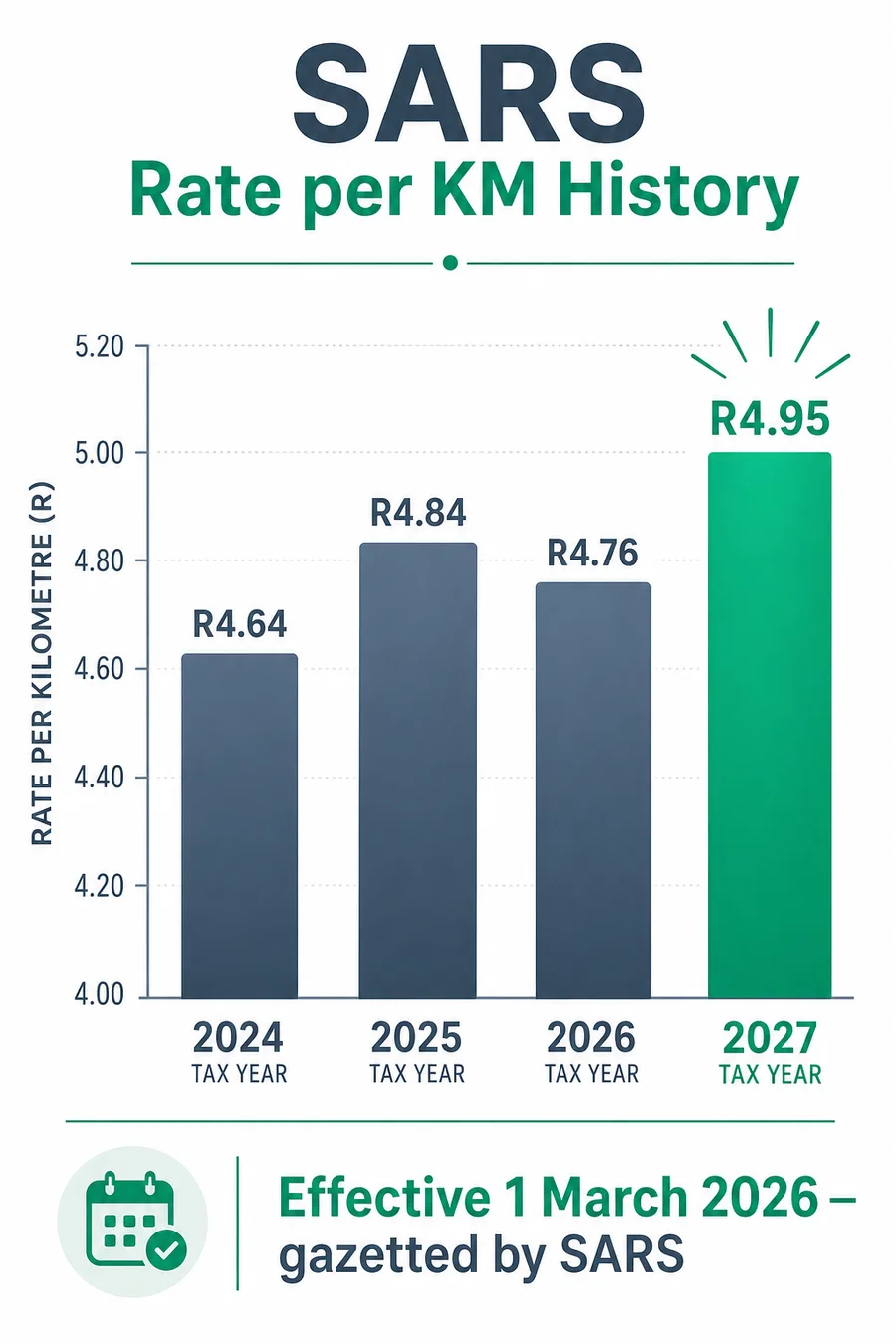
- 2027 tax year (Mar 2026 – Feb 2027)R4.95/km
- 2026 tax year (Mar 2025 – Feb 2026)R4.76/km
- 2025 tax year (Mar 2024 – Feb 2025)R4.84/km
- 2024 tax year (Mar 2023 – Feb 2024)R4.64/km
The 2026/27 rate is a 4.0% increase, driven by higher fuel and maintenance costs.
AA tariewe per km 2026 - opsomming in Afrikaans
Die nuwe SAID-voorgeskrewe tarief vir die 2027-belastingjaar (1 Maart 2026 tot 28 Februarie 2027) is R4,95 per kilometer. Dit is die maksimum belastingvrye terugbetaling wat 'n werkgewer per sake-kilometer kan betaal sonder dat 'n rylogboek nodig is - solank dit jou enigste reisvergoeding is.
Die AA (Automobiel Assosiasie van Suid-Afrika) publiseer afsonderlik sy Voertuig Lopende Koste-syfers wat afskrywing, finansiering, versekering, brandstof, dienste en bande insluit. Hierdie syfers is gewoonlik 'n paar rand per km hoër as die SAID-tarief, veral op duurder voertuie. Gebruik die SAID-tarief vir jou belastingopgawe; gebruik die AA-syfers om te bereken wat dit werklik kos om jou voertuig te besit.
Vinnige antwoorde
- Wat is die AA tarief per km vir 2026? R4,95/km (vereenvoudigde SAID-koers, geldig 1 Maart 2026).
- Het ek 'n rylogboek nodig? Nee - nie vir die vereenvoudigde R4,95-koers nie, mits jy geen ander reisvergoeding ontvang nie.
- Kan ek my rit werk toe eis? Nee. SAID beskou huis-tot-werk-reise as privaat. Slegs sake-kilometers tel.
- Diesel of petrol? Die SAID-skaal onderskei nie tussen brandstoftipes nie; diesel is gewoonlik 5–10% goedkoper per km in praktyk.
Vir die volledige koersskaal, gebandeer volgens voertuigwaarde, sien die tabel hierbo. Bronne: SAID PAYE-GEN-01-G03-A01 (2027-belastingjaar).
Subsistence allowances 2026/27
If your employer provides a daily subsistence allowance instead of (or in addition to) the travel rate, the tax-free maximum amounts effective 1 March 2026 are:
Meals + incidental (local)
R595/day
For overnight business travel in South Africa.
Incidental only (local)
R184/day
Where meals are also reimbursed at actual cost.
Foreign-travel subsistence rates are published per country in the SARS PAYE-GEN-01-G03-A02 annexure. Looking for other tax-deductible items? See our guides on choosing a retirement annuity and tax-free savings accounts (TFSA).
AA rate vs SARS rate - the difference
AA rate
Industry estimate
The Automobile Association of South Africa publishes Vehicle Running Cost (VRC) estimates that include depreciation, finance, insurance, licensing, fuel, services and tyres.
Use it to sanity-check what owning the car actually costs you.
SARS rate
Tax rule
SARS publishes both a cost scale (banded by vehicle value) and a simplified rate (R4.95/km for 2026/27) used as the tax-free reimbursement benchmark.
Use this for your tax return and your travel allowance.
Worked examples (2026/27)
Example 1: Real-estate agent
An agent drives a Hyundai i20 (R280,000). 38,000 km/year, 22,000 km business. SARS cost-scale rate ≈ R4.84/km; annual cost-scale claim = R106,500. SARS simplified at R4.95/km = R108,900. With minimal business mileage and a mid-priced car, the simplified rate wins - no logbook needed. If the vehicle was bought on finance, also factor in how car finance interest interacts with your claim.
Example 2: Field-services engineer
A Hilux 2.8 diesel (R620,000). 55,000 km/year, 40,000 km business. SARS cost-scale rate ≈ R6.42/km; annual cost-scale claim = R256,800. Simplified = R198,000. The R58,800 gap is worth keeping a logbook for.
Example 3: Hybrid-work consultant
A Golf (R420,000). 18,000 km/year, only 6,000 km business. SARS cost-scale ≈ R9.43/km because fixed costs spread over low mileage; cost-scale claim = R56,600. Simplified = R29,700. Cost scale wins, but the logbook overhead is hard to justify for 6,000 km.
What a SARS logbook must contain
A logbook is the difference between a deductible cost-scale claim and a fully taxable allowance. SARS requires the following per business trip:
| Date | Open km | Close km | Distance | Reason |
|---|---|---|---|---|
| 06/05/26 | 85,230 | 85,288 | 58 km | Client – ABC Ltd, Sandton |
| 06/05/26 | 85,288 | 85,322 | 34 km | Site visit – Midrand |
| 07/05/26 | 85,322 | 85,355 | 33 km | Private |
Record opening and closing odometer readings on the first and last day of the tax year (1 March – 28/29 February). The SARS eLogbook is available as a free download from sars.gov.za. If your driver's licence is up for renewal mid-tax-year, see our drivers' licence renewal cost guide and NaTIS online booking walkthrough.
Frequently asked questions
What is the SARS rate per km for 2026 in South Africa? +
What is the difference between the AA rate and the SARS rate? +
Can I claim AA or SARS rates for my commute to work? +
Do I need a logbook to claim the SARS rate? +
How is the SARS cost scale calculated? +
Is the AA rate the same as the SARS rate? +
What are the SARS subsistence allowances for 2026/27? +
Is diesel cheaper per km than petrol? +
Sources
- · SARS PAYE-GEN-01-G03-A01: Rate per Kilometre Schedule (2027 Tax Year). Gazetted 25 February 2026.
- · SARS Subsistence Allowance: External Annexure for the 2027 tax year (local and foreign rates).
- · SARS PAYE-GEN-01-G03: Guide for Employers in respect of Allowances (2027 tax year).
- · AA Vehicle Rates Calculator: aa.co.za/vehicle-rates-calculator.
MoneyToday is an editorial publication. Figures on this page are taken from the published SARS Government Gazette notice and are not personal tax advice. For a binding tax position consult SARS or a registered tax practitioner.
Related guides
Vehicle
How car finance works in SA
Interest rates, balloons, and total cost - what you actually pay over the term.
Loans
Compare personal & vehicle loans
Financing the car you're claiming for? Compare Capitec, African Bank, FNB and more side-by-side.
Loans
PEP (Capfin) loans: the real cost
Need cash for fuel or repairs before payday? The full cost of a Capfin loan, fees included.
Vehicle
Best car trackers in SA
Tracker comparison - insurance discounts and recovery rates.
Tax
Choosing a retirement annuity
Another tax-deductible expense for the same return - what to look for.
More tools
All free calculators
Loan, savings and vehicle calculators in one place.